Optimal stereo speaker placement : Part III
Optimal stereo speaker placement is an iterative process that involves balancing room acoustics, speaker design specifications and geometric positioning to achieve a flat frequency response and accurate stereo image at the main listening position (MLP).
The placement process can be categorized into establishing foundational geometry, managing wall proximity (especially for bass frequencies), and addressing room reflections.
Fine-Tuning and Acoustic Environment
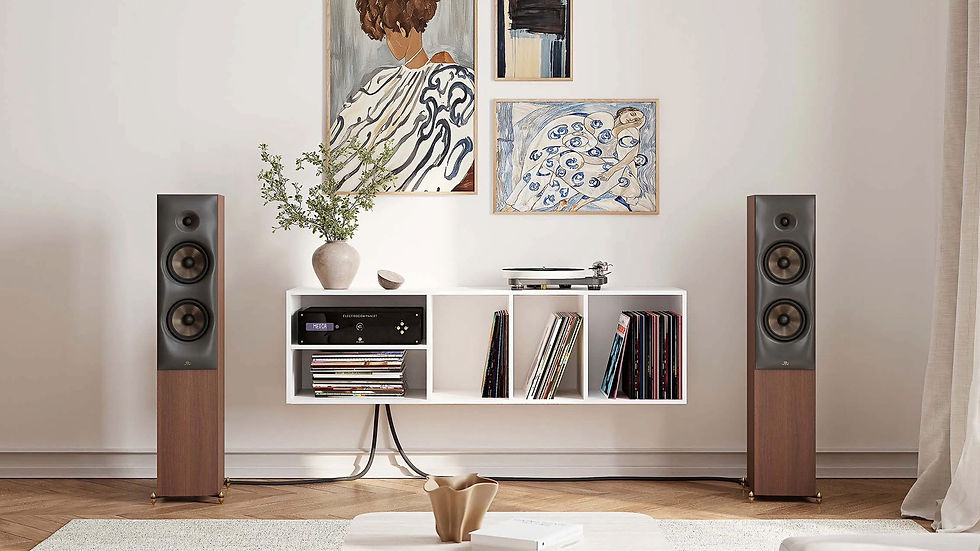
Proper placement works synergistically with acoustic treatment to control reflections, which compromise clarity and stereo image.
1. Toe-In (Angling)
Toe-in is the practice of angling speakers inward toward the listener.
• Standard Recommendation: Typically, angling the speakers inward by 15 to 30 degrees helps narrow sound dispersion, reduce side-wall reflections, and tighten the stereo image at the central listening position.
• Modern Designs: Speakers with constant directivity or coincident driver technology (like KEF's Uni-Q) often require little to no toe-in (firing straight ahead) because they already offer wide dispersion and excellent off-axis response, creating a broader optimal listening area.
• Experimentation: Always consult the user manual, but final adjustments should be made empirically by ear, focusing on soundstage depth and tonal quality.
2. Treating First Reflection Points (FRPs)
First Reflection Points are critical areas on the side walls, ceiling, and floor where sound waves bounce off before reaching the ear, causing destructive interference (comb filtering).
• Identifying FRPs: The Mirror Test is the simplest way to locate FRPs: while seated in the listening position, have a friend move a mirror along a wall until you can see the speaker driver reflected. That spot is the FRP.
• Side Walls and Ceiling: These areas should be treated with absorption panels (often called a "ceiling cloud" for the ceiling) to eliminate reflections. Absorption is the high-priority solution for side walls in critical listening environments.
• Floor: Floor reflections are effectively managed by placing a thick, dense area rug or carpet between the speakers and the listener. Rugs are effective at absorbing high frequencies (above 1 kHz) and reducing flutter echo.
• Rear Wall: The wall behind the listener requires acoustic treatment, ideally heavy low-frequency bass traps, to absorb late reflections and control modal energy.
3. The Cardas Golden Ratio Placement System
For symmetrical, rectangular rooms, the Cardas Golden Ratio method uses the Room Width (RW) to mathematically determine placement based on distributing modal energies harmoniously.
• Speaker to nearest side wall: RW×0.276.
• Speaker to wall behind speaker (front wall): RW×0.447.
However, when setting up speakers in small rooms, SBIR mitigation (Strategy A or B) must take precedence if the calculated distance falls within the critical intermediate danger zone.
Ultimately, optimum placement is an experimental process. After setting up based on these guidelines, use critical listening sessions and acoustic measurement tools (like Room EQ Wizard) to verify that detrimental peaks and nulls have been minimized.
