The Heart of the System: Understanding Amplifiers
Updated: Jun 24
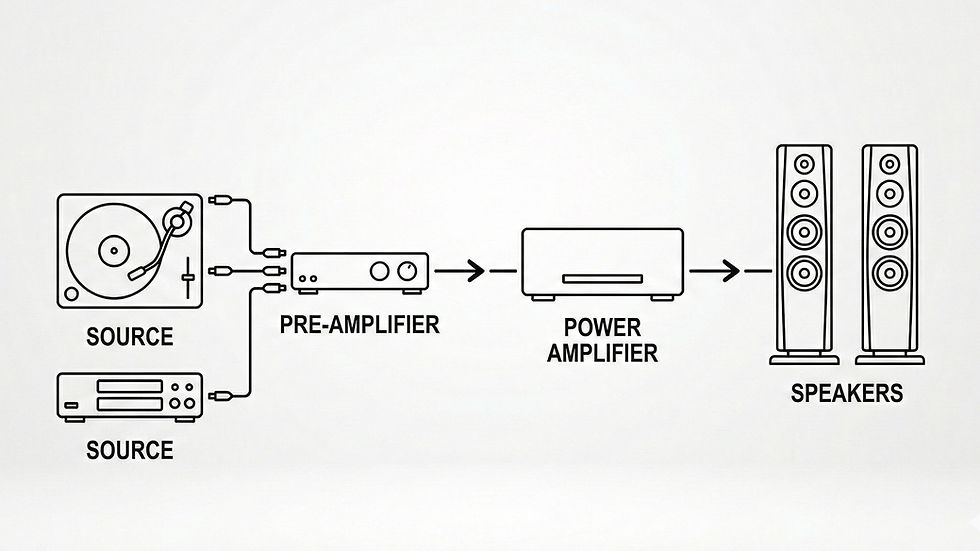
If the 'Source' is the story, the Amplifier is the storyteller. Understanding the different types of amplifiers and what each one does is the key to giving that story enough energy to move heavy speaker cones without losing the emotion of the music.
A Brief History: From Glowing Glass to Silent Silicon
Before we look at the different types of amplifiers, it’s helpful to know what’s inside them. Over the decades, the "internals" of amplifiers have changed drastically:
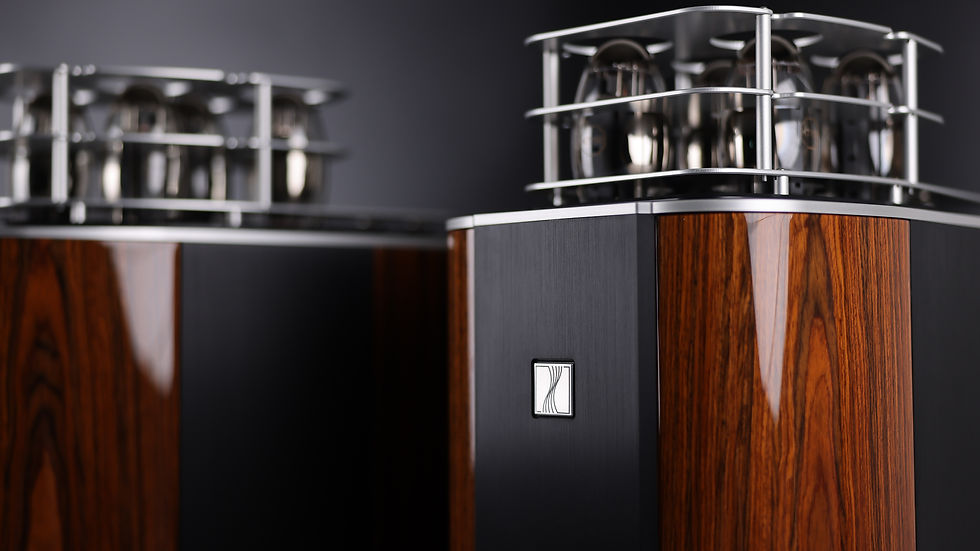
The Tube Era (1920s–1960s): The first amplifiers used Vacuum Tubes (which look like lightbulbs). They run hot and glow, but they are loved for their "warm" and "musical" sound.
The Transistor Revolution (1970s–Present): Engineers moved to Solid State technology (transistors). These are smaller, more reliable, and don't get as hot. They provide a very "fast" and "clean" sound.
The Digital Age (Today): We now have Class D amplifiers that use high-speed switching (almost like a computer) to be incredibly powerful yet small enough to fit in a pocket.
1. The Phono Preamplifier (The Whisper Interpreter)
If you have a turntable, you need this first. The signal coming off a record needle is so quiet it’s almost a whisper.
The Role: It boosts that tiny signal and "fixes" the tonal balance (vinyl records are recorded with very low bass to fit in the grooves; this puts the bass back in).
Pros: Essential for vinyl lovers; allows you to hear the full detail of a record.
Cons: It’s an extra piece of gear and an extra set of cables to manage.
2. The Preamplifier (The Traffic Controller)
Think of the Preamp as the "Brain" or the "Control Center". It doesn't provide power; it provides control.
The Role: It lets you switch between your sources like your streamer, CD player, and turntable. It also manages the volume.
Pros: Keeps the signal organized and clean; allows for very precise volume control.
Cons: On its own, it cannot make sound—it must be connected to a power amp.
3. The Power Amplifier (The Heavy Lifter)
This is the "Brawn." It takes the organized signal from the Preamp and uses raw electricity from your wall to turn it into a massive wave of energy.
The Role: To physically push and pull the speakers. It is the most powerful part of the chain.
Pros: Provides the "grip" and "impact" you feel in your chest during a drum solo.
Cons: Usually very heavy, generates heat, and often has no buttons or knobs on the front—it just does one job.
4. The Integrated Amplifier (The All-In-One)
For many people, this is the perfect starting point. It combines the Preamp and the Power Amp (and often the Phono Pre) into one single box.
The Role: To be the "Swiss Army Knife" of your system. You plug your sources in the back and your speakers into the other side.
Pros: Saves space, uses fewer cables, and is generally more affordable than buying "separates."
Cons: If one part breaks, the whole box goes to the shop. It’s also harder to "upgrade" just one section of your system later on.
Which one should you choose?
The Minimalist: Go for an Integrated Amplifier. It’s clean, efficient, and sounds incredible in most modern homes.
The Hobbyist: Go for Separates (a dedicated Preamp and Power Amp). This gives you the freedom to mix and match different "sounds" - like a warm Tube Preamp paired with a powerful Solid State power amp.