The Anatomy of Great Sound: A Beginner’s Guide to Stereo Components
In this beginner's guide, we break down the essential stereo system components and how the signal flows from one to the next to bring your music to life. In the world of audio, we often talk about "transparency," "soundstage," and "musicality." But before we can appreciate the nuances of a symphony or the grit of a rock vocal, we have to understand the machinery making it happen.
A stereo system is more than just a collection of boxes; it is a signal chain. Think of it as a relay race where electricity carries the "baton" (the music) from the recording to your ears. If one runner falters, the whole race is affected.
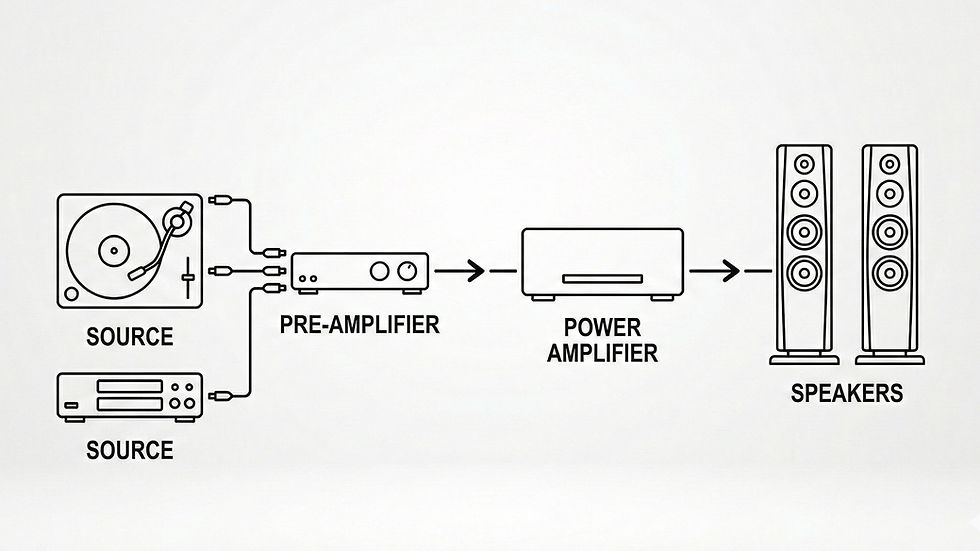
Here is the essential breakdown of the components that bring your music to life.
1. The Source: Where the Music Begins
Every great performance needs a starting point. In a stereo system, the Source is the device that reads your music. Whether it’s physical or digital, the source’s job is to provide a clean, raw electrical signal.
Examples: A turntable reading grooves on vinyl, a CD player, or a high-resolution network streamer playing files from the cloud.
2. The DAC: The Digital Translator
Most of our music today is digital (0s and 1s), but our speakers - and our ears - are analog. A DAC (Digital-to-Analog Converter) acts as a translator.
The Job: It takes that digital code and converts it into a continuous electrical wave.
Why it matters: A high-quality DAC ensures that the translation is "bit-perfect," meaning no detail is lost or distorted during the conversion.
3. The Preamplifier: The Control Center
The Preamplifier (or "preamp") is the brain of your system. This is where you interact with your music.
The Job: It acts as a traffic cop, allowing you to switch between different sources (like moving from your turntable to your streamer) and adjust the volume.
Terminology: In audio, we want the preamp to be "transparent," meaning it manages the signal without adding any hiss or "color" of its own.
4. The Power Amplifier: The Muscle
The signal leaving your preamp is very weak - barely enough to power a pair of headphones, let alone large speakers. The Power Amplifier provides the "brawn" required to drive the system.
The Job: It takes the weak signal and uses electricity from your wall outlet to multiply its strength.
Terminology: This strength is measured in Watts. The more "muscle" an amp has, the better it can control the movement of your speakers, especially during loud or complex musical passages.
5. The Loudspeakers: The Translators
This is where the magic happens. The Loudspeakers are the final destination in the chain.
The Job: They take the high-power electrical signal from the amplifier and turn it into physical movement. This movement vibrates the air, creating the sound waves you hear.
Terminology: Inside the speaker cabinet are Drivers - the circular cones that move back and forth to create sound.
6. Cables: The Connectors
Cables are the veins of your system. They ensure the signal travels from one component to the next without picking up interference from your Wi-Fi or other electronics.
Interconnects: These connect your sources to your preamp.
Speaker Cables: These carry the heavy-duty power from your amp to your speakers.
The "All-in-One" Solution: The Integrated Amplifier
If you are looking for a streamlined setup, you might encounter an Integrated Amplifier. This is a single chassis that houses the Preamplifier and the Power Amplifier (and often the DAC) in one box. It’s a fantastic, space-saving way to get sound without a stack of separate components.
Summary
Building a system is about balance. Each component has a specific role to play in preserving the integrity of the music. When these components are matched correctly, the equipment "disappears," and all that’s left is the performance.