Understanding Speakers: The Heart of Your Audio Experience
The speaker is where the "equipment" ends and the "music" begins. While every other component in your system handles electricity, the speaker handles physics.

A Brief History: From Paper Cones to Exotic Materials
The basic design of a speaker hasn't changed much since the late 1920s, but the materials certainly have:
The Early Days: Early speakers used paper cones and heavy permanent magnets. They were often large because they had to be efficient to work with the low-powered amplifiers of the time.
The Material Science Era: As technology advanced, engineers began using Kevlar, Aluminum, Silk, and even Beryllium or Synthetic Diamonds to make the cones stiffer and lighter.
The Modern Goal: To create a cone that is light enough to move instantly but stiff enough not to bend or "distort" when the music gets loud.
1. The Anatomy of a Speaker (Drivers)
A single speaker cabinet usually contains multiple "drivers," each specializing in a different part of the sound spectrum:
The Tweeter (The Highs): The smallest driver. It handles high-pitched sounds like cymbals, violins, and the "air" in a singer’s voice.
The Midrange (The Heart): This driver handles the frequencies where most human voices and instruments like guitars live.
The Woofer (The Lows): The largest driver. It moves the most air to create the "thump" of a bass drum or the rumble of a bass guitar.
The Crossover: An invisible "brain" inside the box that directs the right frequencies to the right driver (lows to the woofer, highs to the tweeter).
2. Common Types of Speakers
Bookshelf Speakers (The Compact Performers)
Designed to sit on a stand or a shelf, these are smaller and usually have two drivers (a tweeter and a mid-woofer).
Pros: Excellent for smaller rooms; they often provide a very "focused" and clear image of where the instruments are.
Cons: They don't move enough air to produce deep, "room-shaking" bass.
Floor-standing / Tower Speakers (The Full Scale)
These tall cabinets sit directly on the floor and usually house multiple woofers.
Pros: They can play much louder and deeper than bookshelf speakers. They provide a "big" sound that feels like a live concert.
Cons: They take up more visual space and require a larger room to sound their best without the bass becoming "boomy."
Subwoofers (The Foundation)
A dedicated speaker box designed only to play the very lowest frequencies.
Pros: Allows your main speakers to focus on the melody while it handles the heavy lifting of the bass.
Cons: Can be difficult to "blend" perfectly with your main speakers so it doesn't sound like a separate box.
3. Passive vs. Active Speakers
This is a common point of confusion for beginners:
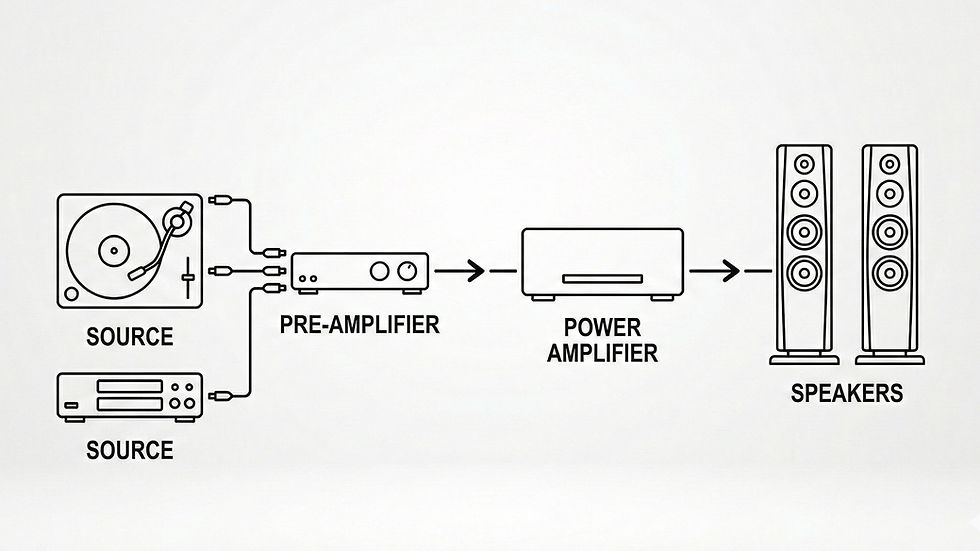
Passive Speakers: These have no built-in power. You must connect them to an external amplifier using speaker cables. (This is the most common setup in high-end audio).
Active (Powered) Speakers: These have the amplifier built directly into the cabinet. You just plug them into the wall and connect to your pre-amp using interconnect cables.
Pros: No need for a big stack of gear; the built-in amp is perfectly matched to the drivers.
Cons: Harder to upgrade—if you want a better amp, you have to buy entirely new speakers.
Pro-Tip: The "Sweet Spot"
Because speakers are physical, where you put them in your room matters more than almost anything else. Even the most expensive speakers in the world will sound "thin" or "muddy" if they are placed incorrectly. In the next posts, we will tell you about speaker placement.