From Grooves to Gigabytes: The Evolution of the Audio Source
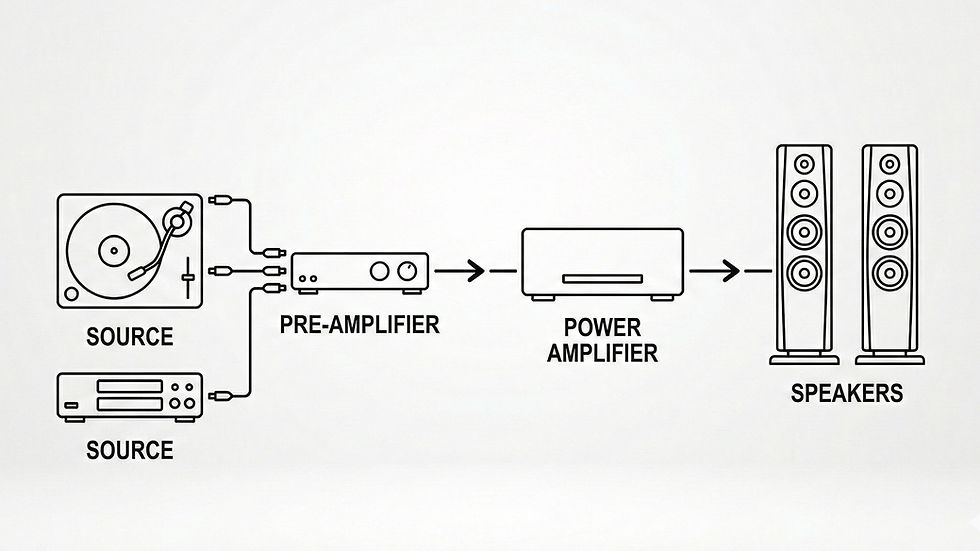
In audio, the Source is where the story begins and few stories trace audio source evolution as vividly as the last century's journey from physical vibrations to magnetic fields, and finally to invisible streams of data.
Here is a look at the history and technical "magic" behind the four most iconic audio sources.

1. Vinyl Records (The Analog Pioneer)
The Year: 1948 (The modern 12-inch "LP" format)
How it Works: Vinyl is a purely mechanical format. The music is physically etched into the record as a continuous, V-shaped groove.
The Technical Bit: As the record spins, a diamond needle (stylus) rides inside that groove. The tiny bumps in the groove walls cause the needle to vibrate. A magnet inside the cartridge moves in sync with those vibrations, creating a tiny electrical signal.
The Experience: Because it’s a physical representation of the sound wave, vinyl is often described as "warm" and "tangible."
2. Magnetic Tape (The Portable Revolution)
The Year: 1963 (The introduction of the Compact Cassette)
How it Works: Unlike vinyl, which uses physical bumps, tape uses magnetism. The plastic film inside a cassette is coated with tiny magnetic particles.
The Technical Bit: When you record, a "recording head" uses electricity to arrange those magnetic particles into specific patterns. During playback, the "playback head" reads those patterns and turns them back into an electrical current.
The Experience: Cassettes brought music into our cars and onto the streets, introducing the concept of the "mixtape" to the world.
3. The Compact Disc (The Digital Dawn)
The Year: 1982
How it Works: The CD was a massive leap forward, replacing physical grooves with digital "pits."
The Technical Bit: A CD stores music as a series of microscopic bumps and flat areas (pits and lands) representing 0s and 1s. A laser beam shines on the disc as it spins; when the light hits a flat area, it reflects back perfectly, but when it hits a bump, it scatters. A sensor tracks these changes in light to "read" the digital code.
The Experience: The CD introduced "perfect" silence—gone were the pops and hisses of analog formats, replaced by crystalline clarity.
4. Digital Streamers (The Modern Era)
The Year: mid-2000s (Spotify launched in 2006; Tidal/High-Res later)
How it Works: Streaming removes the physical disc entirely. The music lives on a distant server and travels to your home as "data packets" over the internet.
The Technical Bit: A streamer is essentially a specialized computer. It pulls the data from the cloud, organizes the packets into the correct order, and feeds them into a DAC (the translator we discussed in our last post).
The Experience: Streaming offers the ultimate convenience—access to millions of songs at the touch of a screen, often in quality that now exceeds that of a CD.
Which source is best?
There is no "wrong" answer. Many audiophiles love Vinyl for the ritual and the warmth, while others prefer Streaming for its incredible resolution and ease of use. At The Sound Company, we believe the best source is the one that makes you want to listen to more music.